The Judge Detects. It Doesn't Decide.
Part of the Golden Thread (8 of 15)
Previous: The Semantic Firewall · Next: Judge Assurance · See the full sequence
Why using LLMs to block transactions is a mistake
When teams discover that guardrails miss things, the instinct is to add another AI layer that can catch what rules-based systems can't. An LLM that evaluates every transaction. If it spots a problem, block it.
This is a mistake. A well-intentioned, logical mistake - but a mistake.
One clarification before the argument. The mistake is asking the Judge to block, and the Judge is only one of the reviewing controls that sit behind your guardrails. Reviewing is a spectrum, not a single slow step. A semantic firewall reviews the intent of a request, a prohibited ask reworded, translated, or indirected to mean the same thing, and because it checks meaning rather than reasoning over full behaviour it is fast enough to run inline and gate a call before it executes, the same way a guardrail does one level up in abstraction. The Judge is the deep end of that spectrum: it evaluates unknown-bad content and behaviour against declared intent, with chain-of-thought reasoning over the whole context, and that depth takes real time. This page is about that deep evaluator specifically. When it says the Judge should detect rather than decide, it is not saying no reviewing control may ever gate. It is saying the slow, thorough one should not.
The Appeal of Active Blocking
The reasoning makes sense on the surface:
- Guardrails catch known patterns
- LLMs can understand context and nuance
- Therefore, an LLM should evaluate and block suspicious transactions
It's the same logic that drives spam filters, fraud detection, and content moderation. Add intelligence. Catch more. Block faster.
But AI-evaluating-AI is different. Here's why.
Three Reasons the Judge Shouldn't Block
1. Latency Kills
LLM evaluation takes time. Even fast models need hundreds of milliseconds. Complex evaluation with reasoning? Seconds.
Add that to every customer interaction and you've destroyed the experience. Chatbots feel sluggish. APIs miss SLAs. Users leave.
Guardrails work because they're fast - pattern matching in single-digit milliseconds. The Judge is valuable precisely because it's thorough. Thoroughness and speed are opposing forces.
The semantic firewall sits between the two: fast enough to gate inline, but checking intent rather than surface pattern. It is a reviewing control that can block in real time, because catching a known-bad intent cheaply is a shallow check, not a deep one. The Judge occupies the far end, and that depth is exactly why real-time blocking is the wrong job for it.
2. False Positives Create Harm
The Judge will be wrong. Not often, maybe, but sometimes. It will flag a legitimate transaction as suspicious.
If the Judge only detects, a false positive means a human reviews something that didn't need review. Annoying, but contained.
If the Judge blocks, a false positive means a customer can't complete a transaction. A patient doesn't get information. A user is locked out. Support tickets pile up. Lawyers get involved.
The failure modes are asymmetric. Detection failures waste internal time. Blocking failures harm customers.
3. Accountability Requires Humans
GDPR Article 22 grants individuals the right not to be subject to decisions based solely on automated processing that produce legal or significant effects.
An AI that blocks a transaction is making an automated decision. The customer can't proceed because an algorithm said no.
An AI that flags a transaction for human review is providing information. A human looks at the flag. The human decides. The human is accountable.
This isn't a technicality. It's the difference between defensible governance and regulatory exposure.
The Right Pattern
The Judge operates after the fact, reviewing what has already happened:
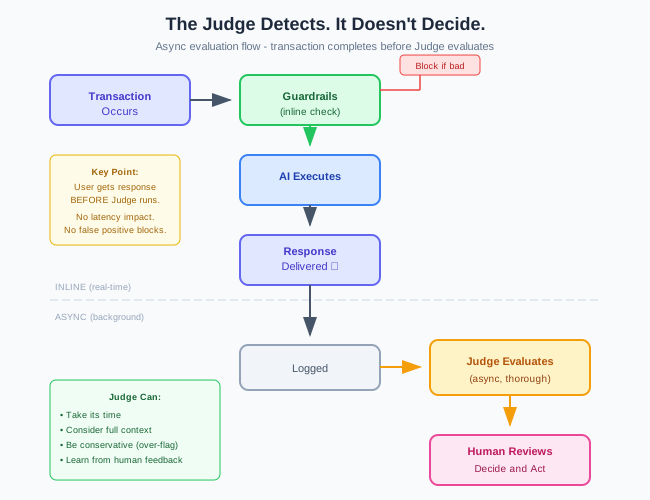
The transaction completes before the Judge evaluates. The Judge informs future action; it doesn't gate current action.
This is where the Judge parts company with the rest of the reviewing layer. Reviewer controls may detect and decide: the deterministic scanners and the semantic firewall catch something and gate the call inline, blocking it before it executes. The LLM-as-judge does not decide. It runs after the action has already completed, an after-action check that surfaces concerns for a human rather than blocking anything itself.
What the Judge Does Well
Freed from real-time blocking, the Judge can:
-
Take its time. Complex evaluation with chain-of-thought reasoning? No problem. The user isn't waiting.
-
Consider context. Review the full conversation, not just one message. Look at patterns across sessions.
-
Be conservative. Flag anything uncertain. Better to over-flag for human review than under-flag and miss something.
-
Learn from feedback. When humans disagree with findings, use that to improve. The feedback loop only works if there's a human in it.
Making Human Oversight Scalable
The Judge doesn't replace human oversight. It makes human oversight possible at scale.
Without the Judge, human review means sampling. Maybe 1% of transactions. Maybe less. You're hoping problems are common enough to appear in your sample.
With the Judge, human review is targeted. 100% of transactions evaluated; only anomalies surfaced for human attention. Humans focus on what matters.
The Judge is a force multiplier, not a replacement.
The Bottom Line
If you're tempted to build an LLM that blocks transactions in real-time, resist. You'll add latency, harm customers, and create accountability gaps.
Instead, build a Judge that: - Operates asynchronously - Evaluates thoroughly - Flags concerns - Routes to humans
Then let humans decide.
The Judge detects. Humans decide. Keep it that way.