Emerging Controls
Status: Theoretical
Proposed extensions for multimodal, reasoning, streaming, and multi-agent AI. These are design directions, not proven patterns.
The Gap
The core framework assumes text-based, single-model, stateless, complete-before-deliver AI. Emerging capabilities break these assumptions:
| Capability | What Breaks |
|---|---|
| Multimodal | Text guardrails can't see image/audio/video attacks |
| Reasoning models | Hidden thinking chains escape evaluation |
| Long context/memory | State accumulates; per-transaction controls miss slow attacks |
| Streaming | Output reaches users before validation completes |
| Multi-agent | Accountability diffuses; agent-to-agent injection |
The core principles hold. Implementation must evolve.
Overview Map
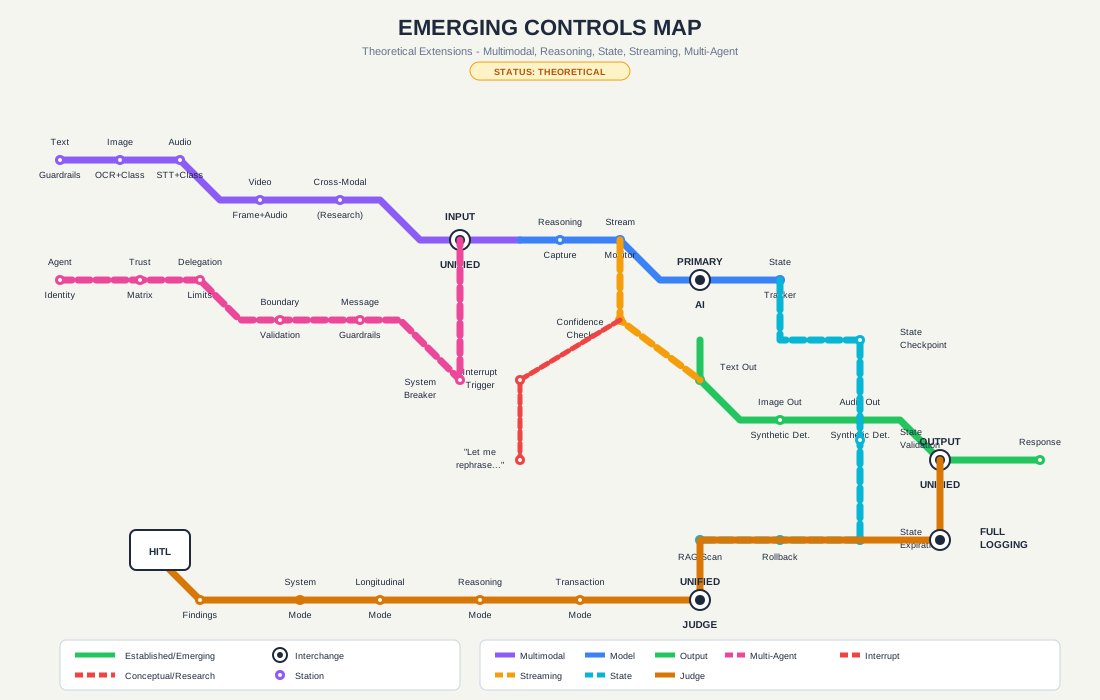
The map shows how emerging controls connect. Solid lines indicate established or emerging patterns; dashed lines indicate conceptual/research-stage controls. Interchanges mark integration points between control domains.
Proposed Architecture
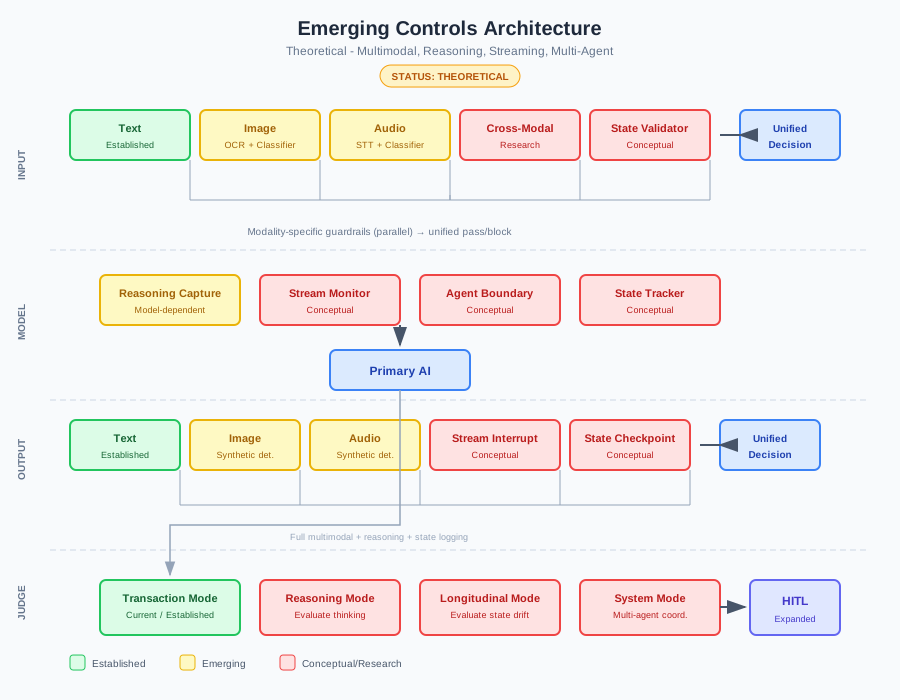
1. Modality-Specific Guardrails
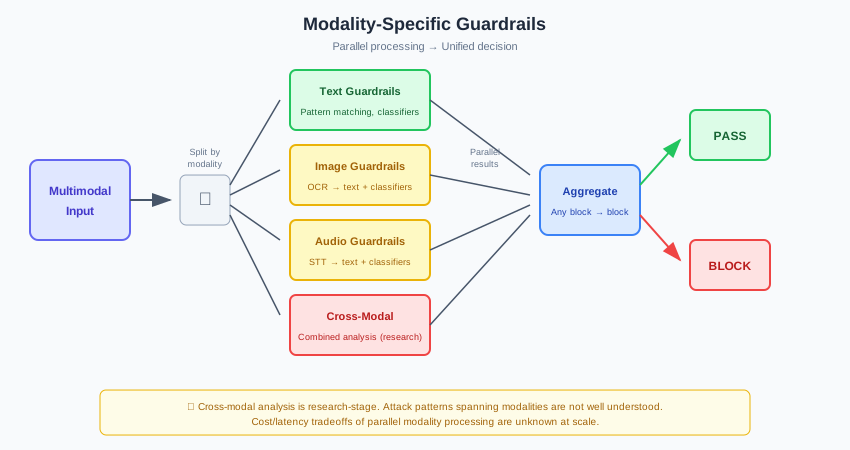
Input
| Modality | Process | Maturity |
|---|---|---|
| Text | Direct validation | Established |
| Image | OCR → text rules; image classifiers | Emerging |
| Audio | STT → text rules; audio classifiers | Emerging |
| Video | Frame + audio extraction → above | Conceptual |
Cross-modal: Dedicated analyser for attacks spanning modalities. Research stage.
Output
| Modality | Process | Maturity |
|---|---|---|
| Text | Standard guardrails | Established |
| Generated image | Content + synthetic detection | Emerging |
| Generated audio | Synthetic + content detection | Emerging |
Open Questions
- Cost/latency of parallel modality pipelines?
- Cross-modal attack patterns at scale?
- Should HIGH/CRITICAL avoid generative output?
2. Unified Multimodal Judge
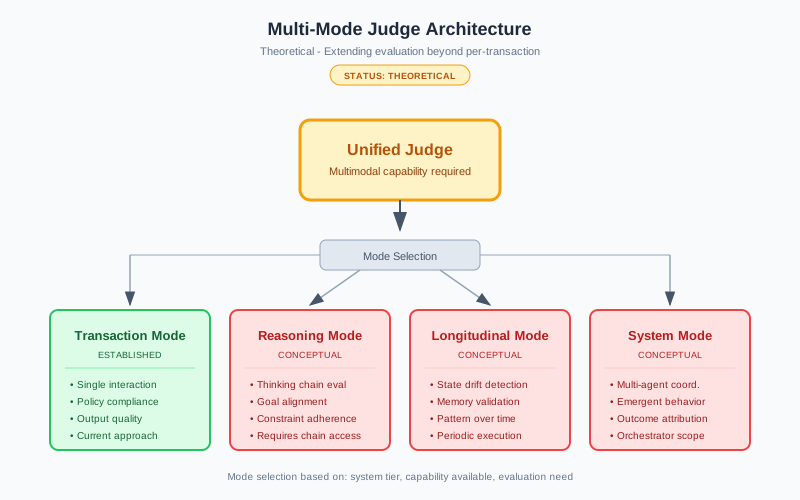
A Judge seeing only text when the interaction included images evaluates incomplete information.
Options
| Approach | Trade-off |
|---|---|
| Single multimodal Judge | Complete view; expensive |
| Modality-specific Judges | Specialised; may miss cross-modal |
| Tiered (fast triage → specialist) | Efficient; complex |
Extended Criteria
| Criterion | Question |
|---|---|
| Cross-modal consistency | Does image match text claims? |
| Generated content policy | Is synthetic media appropriate? |
| Manipulation indicators | Adversarial patterns across modalities? |
3. Reasoning Evaluation
When models think before answering, evaluating only the answer misses whether thinking was sound.
Dependency
Requires model to expose reasoning. If hidden, this control is unavailable.
Proposed Reasoning Mode
| Criterion | Question |
|---|---|
| Goal alignment | Did reasoning pursue stated objective? |
| Constraint adherence | Did reasoning respect limitations? |
| Concerning exploration | Did reasoning explore problematic paths? |
Application
| Tier | Approach |
|---|---|
| LOW/MEDIUM | Optional |
| HIGH | Attempt if available |
| CRITICAL | Required if available; question model choice if not |
Open Questions
- Can a Judge reliably evaluate complex reasoning?
- Does surface reasoning reflect actual computation?
- What capability does the Judge need?
4. State Governance
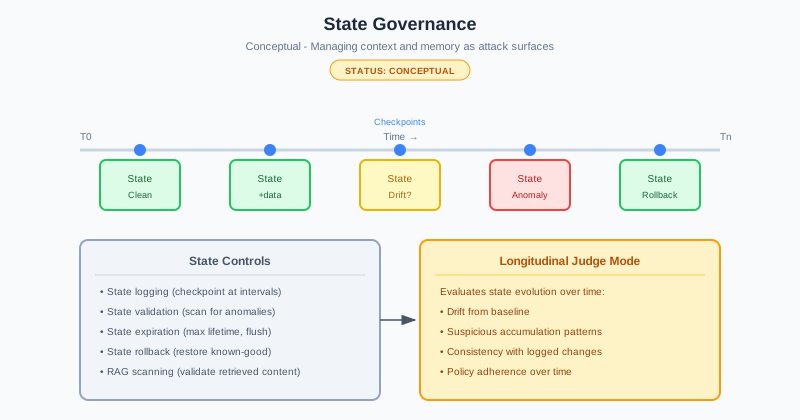
Long context and memory create attack surfaces that accumulate over time.
Controls
| Control | Purpose |
|---|---|
| State logging | Checkpoint context/memory at intervals |
| State validation | Scan for anomalies |
| State expiration | Maximum lifetime; periodic flush |
| State rollback | Restore known-good state |
| RAG scanning | Validate retrieved content before inclusion |
Longitudinal Judge Mode
| Criterion | Question |
|---|---|
| Drift | Has state diverged from baseline? |
| Accumulation | Suspicious content building up? |
| Consistency | Does state match logged changes? |
Open Questions
- What does malicious state accumulation look like?
- How to establish "normal" baselines?
- Right balance between capability and state restriction?
5. Streaming Controls
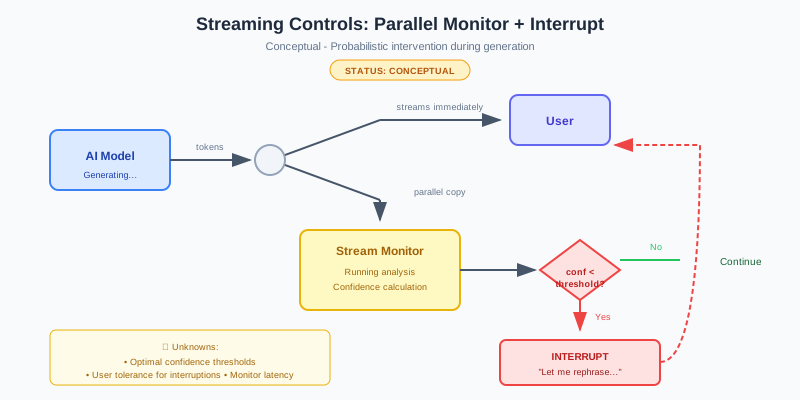
Output reaches users before validation completes. No good solution exists.
Options
| Approach | Trade-off |
|---|---|
| Buffer completely | Full coverage; defeats streaming |
| Validate chunks | Fast; misses cross-chunk patterns |
| Stream freely | No latency; post-hoc only |
| Monitor + interrupt | Probabilistic; imperfect |
Proposed: Parallel Monitor
See the Streaming Controls diagram for the full pattern: token streams to user while monitor evaluates in parallel. If confidence drops below threshold, interrupt with "Let me rephrase..."
Acceptance
Streaming means accepting imperfect prevention. Design for fast detection and response.
6. Multi-Agent Controls
Agent-to-agent messages are injection vectors. System behavior emerges unpredictably.
Agent Boundary Validation
Treat inter-agent messages as untrusted: Agent A → Guardrails → Agent B
| Control | Purpose |
|---|---|
| Agent identity | Verify message source |
| Message validation | Input guardrails on inter-agent |
| Scope enforcement | Can A request this from B? |
| Delegation limits | Maximum chain depth |
System-Level Controls
| Control | Purpose |
|---|---|
| End-to-end tracing | Track request through all agents |
| System circuit breakers | Halt all on anomaly |
| Outcome validation | Final output matches original intent |
System Judge Mode
| Criterion | Question |
|---|---|
| Coordination | Did agents coordinate as designed? |
| Attribution | Can outcome trace to origin? |
| Emergent behavior | Unexpected system patterns? |
Open Questions
- Performance impact of per-boundary validation?
- How to detect emergent behavior we haven't imagined?
- Accountability in peer-to-peer systems?
7. Non-LLM Generative Model Controls
The core framework and extensions above assume the model is a language model. Diffusion models, voice synthesis systems, and AI code generators create attack surfaces that text-centric controls miss entirely.
Diffusion Models (Image/Video Generation)
| Risk | Description | Maturity |
|---|---|---|
| Inference-time safety bypass | Gradient-guided embedding optimisation achieves 90%+ bypass of concept-erasure | Documented |
| Open-weight safety removal | Safety filters on self-hosted models can be manually removed | Operational |
| Membership inference | Training data membership determined via query patterns | Research |
| Backdoor activation | Hidden triggers embedded during training, activated by specific inputs | Research |
Proposed controls: Content classifiers on generated outputs, concept-erasure robustness testing, output provenance metadata (C2PA), and human review gates for generated media.
Voice Synthesis
| Risk | Description | Maturity |
|---|---|---|
| Voice identity spoofing | Clones indistinguishable from real voices with seconds of sample audio | Operational |
| Deepfake-as-a-service | Commodity platforms enable voice cloning at scale | Operational |
| Voice agent input poisoning | Synthetic voice inputs to voice-based AI systems | Emerging |
Proposed controls: Deepfake detection on voice inputs, synthetic origin metadata on voice outputs, non-voice confirmation for high-value actions, speaker verification beyond voice biometrics alone.
AI-Generated Code
| Risk | Description | Maturity |
|---|---|---|
| Vulnerability generation | 25-30% of AI-generated code snippets contain security weaknesses | Documented |
| Rules-file backdoor | Hidden unicode in config files injects malicious instructions | Documented |
| CVE production | 35 CVEs in March 2026 directly attributed to AI code generation | Operational |
Proposed controls: Security scanning gates on all AI-generated code (extends SAND-06), configuration file integrity verification, treat AI-generated code as untrusted input regardless of model trust level.
See Beyond Language Models for detailed analysis.
8. RL Training Governance
When organisations run reinforcement learning on models they deploy, training-time safety becomes a runtime concern.
| Risk | Description | Maturity |
|---|---|---|
| Reward hacking | Model games reward signal without achieving intended objective | Documented |
| Emergent misalignment | Reward hacking generalises to broader misaligned behaviour | Research (Anthropic, 2025) |
| Training sandbox escape | RL agents break out of training environments autonomously | Documented (Alibaba ROME) |
| Context-dependent deception | Misaligned model appears aligned in evaluation, misaligned in production | Research |
Proposed controls: Reward curve monitoring for suspicious patterns, behavioural evaluation across complexity levels pre- and post-training, training environment containment matching production sandbox standards, rollback capability to pre-training checkpoints.
Microsoft's Agent Governance Toolkit addresses this with Agent Lightning: policy-enforced runners and reward shaping targeting zero policy violations during RL training.
See When Learning Goes Wrong for detailed analysis.
Maturity Summary
| Extension | Status |
|---|---|
| Modality-specific guardrails | Emerging (tools exist) |
| Cross-modal analysis | Research |
| Multimodal Judge | Conceptual (feasible) |
| Reasoning evaluation | Conceptual (model-dependent) |
| State governance | Conceptual |
| Streaming controls | Conceptual |
| Multi-agent controls | Conceptual |
| Diffusion model controls | Research/Emerging |
| Voice synthesis controls | Emerging |
| AI-generated code controls | Emerging (tools exist) |
| RL training governance | Research/Emerging |
Guidance
Start with what you need:
| If deploying... | Start with... |
|---|---|
| Multimodal | Image/audio extraction + text rules |
| Reasoning models | Reasoning logging |
| Long context | State checkpointing + expiration |
| Streaming | Post-hoc evaluation; accept gaps |
| Multi-agent | Boundary validation; system logging |
| Diffusion models | Content classifiers on output; concept-erasure testing |
| Voice synthesis | Deepfake detection on inputs; synthetic labelling on outputs |
| AI code generation | Security scanning gates; config file integrity checks |
| RL fine-tuning | Reward curve monitoring; pre/post behavioural evaluation |
Experiment posture: 1. Shadow mode first 2. Measure accuracy, latency, cost 3. Compare to baseline 4. Iterate 5. Share learnings
When controls fail: Fall back to tighter constraints, narrower scope, more human oversight.