Controls: Guardrails, Judge, and Human Oversight
1. Guardrails
Real-time controls that block known-bad inputs and outputs.
Input Guardrails
| Control | What It Catches |
|---|---|
| Injection detection | Attempts to override system prompt |
| Encoding detection | Obfuscated attacks (Base64, hex, Unicode) |
| PII detection | Personal data in prompts |
| Content policy | Prohibited request types |
| Rate limiting | Abuse, enumeration |
| Length limits | Context stuffing |
Processing flow:

Output Guardrails
| Control | What It Catches |
|---|---|
| Content filtering | Harmful/inappropriate content |
| PII detection | Personal data leakage |
| Grounding check | Hallucination |
| Format validation | Malformed responses |
Limitations
Guardrails catch known patterns. They miss: - Novel techniques - Semantic variations - Context-dependent violations - Subtle policy violations
This is why the Judge provides the second layer.
For practical implementation guidance - international PII detection, RAG ingestion filtering, secrets scanning, alerting design, and guardrail exception governance - see Practical Guardrails.
Semantic Firewall
Part of the Reviewing Controls layer, alongside the Judge: intent-level enforcement that sits between Guardrails and Model-as-Judge in the request path. Where Guardrails block known-bad patterns and the Judge evaluates unknown-bad content, the semantic firewall catches known-bad intent expressed in wording neither has seen before - a request reworded, translated, or indirected to mean the same prohibited thing.
| Layer | Catches | Speed |
|---|---|---|
| Guardrails | Known patterns | ~10ms |
| Semantic Firewall | Known intent, novel wording | ~15-30ms |
| Model-as-Judge | Unknown-bad, context-dependent | 10ms-5s by tier |
It classifies inbound requests against a declared taxonomy of authorised and prohibited topics/intents using an embedding classifier or distilled intent model - not a general-purpose LLM call. This makes it cheap enough to run on every request, narrowing what actually needs to reach the Judge.
It does not replace the Judge. It routes: pass straight through, escalate to Judge evaluation, or reject outright for high-confidence matches against the prohibited taxonomy.
→ Full detail, build options, and limitations: Semantic Firewall
2. Model-as-Judge
Evaluation of interactions for quality and policy compliance. The Judge can be a large LLM (for async assurance and complex reasoning) or a distilled SLM (for inline, real-time action screening). Both approaches can be combined: an SLM screens every action in under 50ms, while a large LLM audits a sample asynchronously.
→ For model selection guidance, see Model-as-Judge Selection
What the Judge Does
| Function | Description |
|---|---|
| Policy compliance | Did the AI follow guidelines? |
| Quality assessment | Accurate, helpful, appropriate? |
| Anomaly detection | Unusual patterns? |
| Risk flagging | What needs human review? |
What the Judge Does NOT Do
- Block transactions in real-time
- Make final decisions
- Replace human judgment
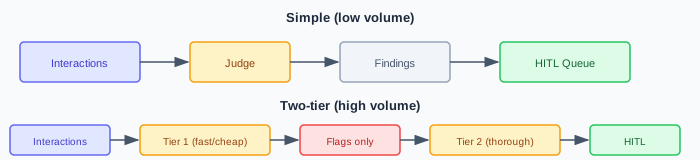
The Judge surfaces findings. Humans decide actions.
Architecture
Evaluation Criteria
| Criterion | Scoring |
|---|---|
| Policy adherence | Pass / Minor / Major violation |
| Accuracy | Verified / Unverified / Incorrect |
| Appropriateness | Appropriate / Borderline / Inappropriate |
| Safety | Safe / Uncertain / Concerning |
Output: PASS / REVIEW / ESCALATE
Deployment Phases
| Phase | Action on Findings |
|---|---|
| Shadow | Log only, measure accuracy |
| Advisory | Surface to humans, learn from feedback |
| Operational | Findings drive workflows |
Start in shadow mode. Validate accuracy before acting.
Accuracy
The Judge will make mistakes.
| Error | Impact | Mitigation |
|---|---|---|
| False positive | Unnecessary review | Tune prompts |
| False negative | Missed violations | Human sampling |
Target: >90% agreement with human reviewers.
3. Human Oversight (HITL)
Humans review findings, make decisions, remain accountable.
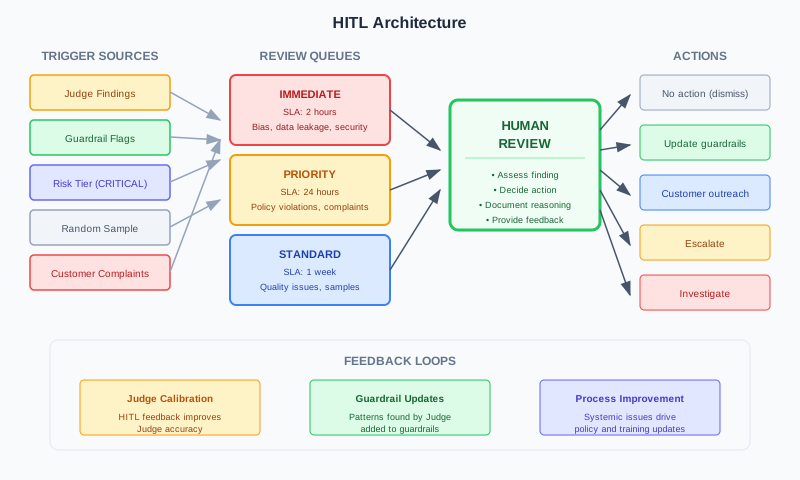
Triggers
| Trigger | Response |
|---|---|
| Judge flag | Review interaction |
| Guardrail block | Review if legitimate |
| User escalation | Human takes over |
| Sampling | Quality assurance |
| Threshold breach | Investigate pattern |
Queue Design
| Queue | SLA | Reviewer |
|---|---|---|
| Critical | 1h | Senior + expert |
| High | 4h | Domain expert |
| Standard | 24h | Trained reviewer |
| Sampling | 72h | QA team |
Actions
| Action | When |
|---|---|
| Approve | Interaction appropriate |
| Correct | Minor issue, fixable |
| Escalate | Needs senior review |
| Block user | Abuse detected |
| Tune | False positive |
Prevent Rubber-Stamping
| Control | Purpose |
|---|---|
| Canary cases | Verify reviewers catch known-bad |
| Time tracking | Flag too-fast reviews |
| Volume limits | Prevent fatigue |
| Inter-rater checks | Measure consistency |
Going Deeper
| Topic | Document |
|---|---|
| What these controls cost in production | Cost & Latency - latency budgets, sampling strategies, tiered evaluation cascade |
| Judge accuracy, drift, and adversarial failure | Judge Assurance · When the Judge Can Be Fooled |
| Semantic firewall detail, build options, and limitations | Semantic Firewall - intent-level boundary enforcement between Guardrails and the Judge |
| Practical guardrail configurations | Practical Guardrails - what to turn on first, encoding detection, international PII |
| When HITL doesn't scale | Humans in the Business Process - using existing business process checkpoints as a detection layer |
| Controls for multi-agent systems | MASO (Multi-Agent Security Operations) Framework - controls across 11 domains for agent orchestration |
| Controls for reasoning models (o1, etc.) | Reasoning Model Controls - trace scanning, instruction adherence, consistency checks |
| Session-level and pre-action evaluation | Output Evaluator - session-aware, pre-action evaluation architecture for agentic systems |
Implementation Order
- Logging - Can't evaluate what you don't capture
- Basic guardrails - Block obvious attacks
- Judge in shadow - Evaluate without action
- HITL queues - Somewhere for findings
- Judge advisory - Surface to humans
- Enhanced guardrails - Add ML detection
- Judge operational - Drive workflows
- Continuous tuning - Improve from findings
At fleet scale: these three layers extend into the space between agents. See MASO for the multi-agent version.