Support Systems Risk
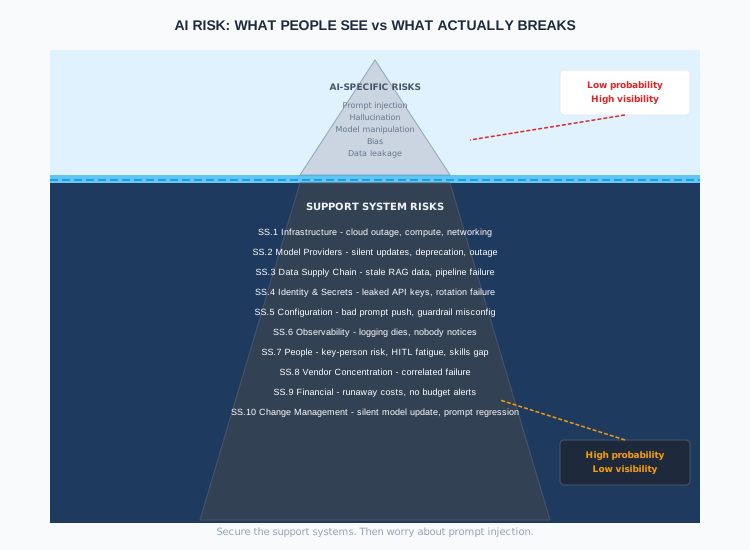
The things most likely to break your AI aren't AI problems.
Why This Matters
The industry focuses here:
| AI-Specific Threat |
Probability |
Industry Attention |
| Prompt injection |
Low-Medium |
Very High |
| Model manipulation |
Very Low |
High |
| Training data poisoning |
Very Low |
High |
| Hallucination |
Medium |
Very High |
But failures actually come from here:
| Support System Failure |
Probability |
Industry Attention |
| API key rotation breaks production |
Medium |
Low |
| Model provider silently changes behavior |
Medium |
Low |
| Logging pipeline fails |
Medium |
Very Low |
| Key person leaves |
High |
Very Low |
| Stale RAG data serves wrong answers |
High |
Low |
| Cost blowout from misconfigured agent |
Medium |
Low |
| Guardrail config pushed without review |
Medium |
Low |
The mundane risks are more likely to hurt you than the exotic ones.
Risk Categories
1. Dependency Risk
Your AI system depends on things you don't control.
1.1 Model Provider Dependency
| Risk |
Scenario |
Impact |
| Provider outage |
OpenAI / Anthropic / Azure API goes down |
AI system unavailable |
| Silent model change |
Provider updates model, outputs shift |
Quality degradation, compliance drift |
| Deprecation |
Model version retired with notice |
Forced migration under pressure |
| Rate limiting |
Hit API limits during peak |
Customer-facing errors |
| Pricing change |
Provider increases costs |
Budget overrun |
| Terms change |
Provider changes data handling terms |
Compliance violation |
| Region unavailability |
Provider exits a region |
Data residency breach |
Controls:
| Control |
Implementation |
Framework Mapping |
| Multi-provider capability |
Ability to switch models |
AI.15 Continuity |
| Version pinning |
Pin to specific model versions |
AI.14 Configuration |
| Behavior monitoring |
Detect output drift after provider changes |
AI.8 Judge |
| Contractual protections |
SLAs, deprecation notice, data handling |
AI.13 Supplier |
| Capacity planning |
Understand rate limits vs demand |
AI.15 Continuity |
1.2 Infrastructure Dependency
| Risk |
Scenario |
Impact |
| Cloud region failure |
Primary region outage |
Full system outage |
| DNS failure |
DNS resolution fails |
Can't reach model APIs |
| Network partition |
Connectivity between services lost |
Partial or full failure |
| Compute exhaustion |
GPU/CPU capacity exceeded |
Degraded performance or outage |
| Storage failure |
Vector DB or logging storage fails |
RAG failure, blind spot |
Controls:
| Control |
Implementation |
Framework Mapping |
| Multi-region |
Deploy across regions where justified |
AI.15 Continuity |
| Health checks |
Monitor all dependencies continuously |
AI.11 Monitoring |
| Graceful degradation |
System continues with reduced function |
AI.15 Continuity |
| Capacity alerts |
Alert before limits hit |
AI.11 Monitoring |
1.3 Data Supply Chain
| Risk |
Scenario |
Impact |
| Stale data |
RAG knowledge base not updated |
AI gives outdated answers confidently |
| Corrupted data |
Bad data injected into knowledge base |
AI gives wrong answers confidently |
| Missing data |
Embedding pipeline fails, new docs not indexed |
AI can't find information that exists |
| Schema change |
Upstream data format changes |
Pipeline breaks silently |
| Source unavailable |
Data source goes offline |
RAG returns no context, AI hallucinates |
This is arguably the highest-probability, highest-impact category. When RAG data is wrong, the AI is confidently wrong - and users trust it.
Controls:
| Control |
Implementation |
Framework Mapping |
| Data freshness monitoring |
Alert when knowledge base staleness exceeds threshold |
AI.5 Data Governance |
| Data validation |
Validate data before indexing |
AI.5 Data Governance |
| Pipeline monitoring |
Monitor ingestion pipelines for failures |
AI.11 Monitoring |
| Source health checks |
Monitor upstream data sources |
AI.11 Monitoring |
| Freshness metadata |
Include "last updated" in AI responses where relevant |
AI.7 Guardrails |
2. Configuration Risk
AI systems are extraordinarily sensitive to configuration. A one-word change in a system prompt can fundamentally alter behavior.
2.1 Prompt and Parameter Configuration
| Risk |
Scenario |
Impact |
| Prompt regression |
System prompt changed, quality drops |
Degraded output quality |
| Parameter drift |
Temperature/token settings changed |
Inconsistent behavior |
| Guardrail misconfiguration |
Rule disabled or threshold changed |
Security control gap |
| Judge criteria change |
Evaluation criteria modified without review |
Assurance gap |
| Circuit breaker override |
Limits relaxed "temporarily" |
Agent runaway |
This is the AI equivalent of a firewall rule change. It should be treated with the same rigour.
Controls:
| Control |
Implementation |
Framework Mapping |
| Version control |
All prompts, parameters, configs in git |
AI.14 Configuration |
| Change approval |
Config changes require review (by tier) |
AI.14 Configuration |
| Drift detection |
Alert on configuration differences from baseline |
AI.14 Configuration |
| Rollback capability |
Instant revert to last known good |
AI.14 Configuration |
| Pre-production testing |
Test config changes before prod |
AI.4 Development |
2.2 Secrets Management
| Risk |
Scenario |
Impact |
| Leaked API key |
Key committed to repo or exposed in logs |
Unauthorised model access, cost |
| Key rotation failure |
Key rotated, dependent services not updated |
Production outage |
| Over-privileged keys |
Key has broader access than needed |
Excessive blast radius |
| No key rotation |
Same key used for months/years |
Increased compromise window |
| Shared credentials |
Multiple services use same key |
Can't isolate or revoke |
Controls:
| Control |
Implementation |
Framework Mapping |
| Secrets vault |
HashiCorp Vault, AWS Secrets Manager, etc. |
AI.15 Cryptography |
| Automated rotation |
Rotate keys on schedule |
AI.15 Cryptography |
| Per-service credentials |
Unique keys per service/environment |
AI.15 Cryptography |
| Secret scanning |
Scan repos and logs for leaked keys |
AI.4 Development |
| Access logging |
Log all API key usage |
AI.11 Logging |
3. Observability Risk
If you can't see it, you can't govern it. Observability failures are silent and dangerous.
3.1 Logging Failures
| Risk |
Scenario |
Impact |
| Log pipeline failure |
Logging service goes down |
Judge has no data, audit trail gap |
| Log volume overflow |
Storage fills, logs dropped |
Missing evidence |
| Log format change |
Upstream changes log schema |
Parsing breaks, Judge can't evaluate |
| Selective logging |
Some interactions not captured |
Biased Judge evaluation |
| Log tampering |
Logs modified after the fact |
Compromised audit trail |
If logging fails, the Judge is blind, HITL has nothing to review, and your audit trail has a gap. This is a governance failure, not just an ops issue.
Controls:
| Control |
Implementation |
Framework Mapping |
| Log pipeline monitoring |
Alert within minutes of logging failure |
AI.11 Monitoring |
| Dead letter queue |
Capture failed log writes for retry |
AI.11 Logging |
| Log completeness checks |
Reconcile expected vs actual log volume |
AI.11 Logging |
| Tamper protection |
Immutable logs for CRITICAL tier |
AI.11 Logging |
| Redundant logging |
Write to multiple destinations for CRITICAL |
AI.11 Logging |
3.2 Monitoring and Alerting
| Risk |
Scenario |
Impact |
| Alert fatigue |
Too many alerts, team ignores them |
Real issues missed |
| Missing alerts |
Key failure modes not monitored |
Blind spot |
| Stale dashboards |
Dashboards show cached/old data |
False confidence |
| Threshold drift |
Thresholds not updated as system evolves |
Alerts no longer meaningful |
Controls:
| Control |
Implementation |
Framework Mapping |
| Alert review |
Quarterly review of alert relevance |
AI.11 Monitoring |
| Alert testing |
Test that alerts fire correctly |
AI.11 Monitoring |
| Escalation paths |
Defined escalation when alerts ignored |
AI.12 Incident |
| Dashboard freshness |
Show "last updated" on all dashboards |
AI.11 Monitoring |
4. People Risk
The H in HITL is a single point of failure.
4.1 Key Person Dependency
| Risk |
Scenario |
Impact |
| Sole prompt engineer |
One person wrote all system prompts |
Can't maintain or debug if they leave |
| Judge expertise |
Only one person understands Judge config |
Assurance capability at risk |
| HITL reviewer |
Domain expertise concentrated in one person |
Review quality drops |
| Platform knowledge |
One engineer knows the platform |
Operational risk |
Controls:
| Control |
Implementation |
Framework Mapping |
| Documentation |
Document all prompts, configs, decisions, rationale |
AI.3 Documentation |
| Cross-training |
Minimum 2 people for every critical function |
AI.14 Training |
| Runbooks |
Documented procedures for common operations |
AI.14 Training |
| Succession planning |
Identified backup for key roles |
AI.1 Governance |
4.2 HITL Sustainability
| Risk |
Scenario |
Impact |
| Reviewer fatigue |
High volume, repetitive reviews |
Quality drops, rubber-stamping |
| Insufficient capacity |
More findings than reviewers can handle |
Queue backlog, SLA breach |
| Skill decay |
Reviewers lose domain sharpness over time |
Review effectiveness drops |
| Turnover |
Reviewers leave, replacements untrained |
Assurance gap during transition |
| Complacency |
Low finding rate leads to inattention |
Miss the one that matters |
This is a known failure mode in every human oversight system. Aviation, nuclear, financial services - all have struggled with this.
Controls:
| Control |
Implementation |
Framework Mapping |
| Workload management |
Monitor reviewer load, redistribute |
AI.9 HITL |
| Quality checks |
Sample-check HITL decisions |
AI.9 HITL |
| Rotation |
Rotate reviewers to maintain attention |
AI.9 HITL |
| Calibration |
Regular calibration exercises |
AI.9 HITL |
| Canary reviews |
Inject known findings to test reviewer attention |
AI.9 HITL |
5. Financial Risk
AI costs are variable, opaque, and can spike without warning.
5.1 Cost Control
| Risk |
Scenario |
Impact |
| Agent cost blowout |
Agentic loop calls API repeatedly |
Unexpected bill |
| Judge cost overrun |
100% sampling on high-volume system |
Budget exceeded |
| Shadow AI |
Teams spin up AI services without oversight |
Uncontrolled spend |
| Pricing surprise |
Provider changes pricing model |
Budget assumptions invalid |
| No budget allocation |
AI costs absorbed into general cloud spend |
No visibility or control |
Controls:
| Control |
Implementation |
Framework Mapping |
| Budget caps |
Hard spending limits per system/team |
AG.2.2 Circuit Breakers |
| Cost alerts |
Alert at 50%, 80%, 100% of budget |
AI.11 Monitoring |
| Cost attribution |
Tag all AI spend to system/team/use case |
AI.3 Inventory |
| Forecast vs actual |
Monthly comparison |
AI.1 Governance |
| Shadow AI detection |
Monitor for unauthorised AI API usage |
AI.3 Inventory |
6. Vendor Concentration Risk
| Risk |
Scenario |
Impact |
| Single model provider |
One provider for all AI capabilities |
Total loss if provider fails |
| Correlated failure |
Model + guardrails + logging all on same platform |
Single event takes out controls and system |
| Vendor lock-in |
Deep integration makes switching costly |
No leverage, no alternatives |
| Geopolitical |
Provider restricted in your jurisdiction |
Forced migration |
Controls:
| Control |
Implementation |
Framework Mapping |
| Multi-provider strategy |
At least evaluate alternatives |
AI.13 Supplier |
| Abstraction layer |
Don't hard-code to one provider's API |
AI.4 Development |
| Exit planning |
Documented migration path |
AI.13 Supplier |
| Control separation |
Don't run guardrails on same platform as AI |
AI.15 Continuity |
7. Change Management Risk
| Risk |
Scenario |
Impact |
| Library upgrade |
Python package update breaks integration |
Production outage |
| SDK change |
Provider SDK breaking change |
Build failures or runtime errors |
| Upstream model update |
Provider updates model behind same version string |
Behavior change |
| Framework migration |
LangChain / LlamaIndex major version change |
Significant rework |
| Undocumented change |
Someone changes something, doesn't tell anyone |
Mysterious behavior shift |
Controls:
| Control |
Implementation |
Framework Mapping |
| Dependency pinning |
Pin all library versions |
AI.4 Development |
| Change log |
All changes documented with rationale |
AI.14 Configuration |
| Staged rollout |
Dev → staging → canary → production |
AI.4 Development |
| Automated testing |
Tests run on every change |
AI.4 Development |
| Change freeze |
Freeze periods for critical business times |
AI.4 Development |
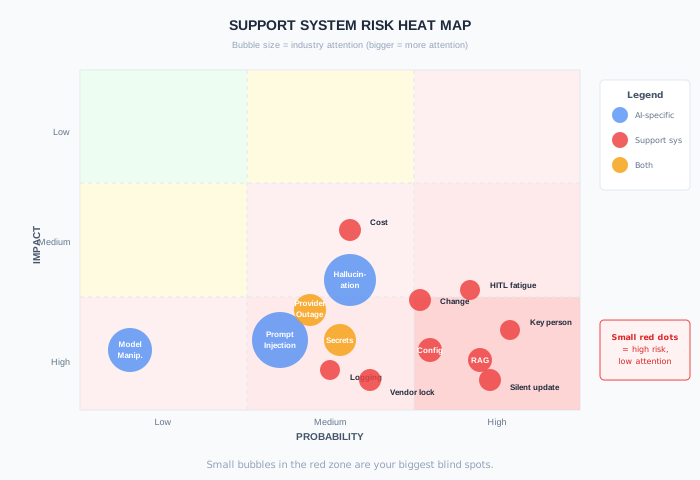
Risk Heat Map
| Category |
Probability |
Impact |
Attention It Gets |
| Data supply chain |
High |
High |
Low |
| People / key person |
High |
High |
Very Low |
| Configuration |
Medium-High |
High |
Low |
| HITL sustainability |
High |
Medium-High |
Very Low |
| Secrets management |
Medium |
High |
Medium |
| Logging failure |
Medium |
High |
Very Low |
| Cost blowout |
Medium |
Medium |
Low |
| Model provider outage |
Medium |
High |
Medium |
| Vendor concentration |
Medium |
Very High |
Low |
| Change management |
Medium-High |
Medium-High |
Low |
| Infrastructure |
Low-Medium |
High |
Medium |
The pattern: high-probability, high-impact risks get the least attention because they're not exciting. Prompt injection is interesting. API key rotation is not. But API key rotation is more likely to take you down.
Framework Integration
These risks map to existing control families, but most need strengthening:
| Support System Risk |
Primary Control Family |
Gap |
| Model provider dependency |
AI.13 Supplier, AI.15 Continuity |
Needs operational runbooks |
| Infrastructure dependency |
AI.15 Continuity |
Needs AI-specific BCP |
| Data supply chain |
AI.5 Data Governance |
Needs freshness monitoring |
| Prompt/config changes |
AI.14 Configuration |
Needs change approval rigour |
| Secrets management |
AI.15 Cryptography |
Needs AI-specific secrets policy |
| Logging failures |
AI.11 Logging |
Needs pipeline monitoring |
| Monitoring gaps |
AI.11 Monitoring |
Needs alert effectiveness review |
| Key person dependency |
AI.14 Training, AI.3 Documentation |
Needs succession planning |
| HITL sustainability |
AI.9 HITL |
Needs workload management |
| Cost control |
AG.2.2 Circuit Breakers, AI.11 Monitoring |
Needs budget caps and attribution |
| Vendor concentration |
AI.13 Supplier |
Needs exit planning |
| Change management |
AI.4 Development, AI.14 Configuration |
Needs AI-specific change process |
Implementation Priority
Do First (Week 1-2)
| Action |
Why |
| Monitor logging pipeline health |
If logging fails, everything downstream is blind |
| Set budget alerts on AI spend |
Prevent surprise bills |
| Document who knows what |
Identify key-person risks |
| Pin model versions |
Prevent silent behavior changes |
| Put prompts in version control |
If they're not in git, they're not controlled |
Do Next (Month 1)
| Action |
Why |
| Implement data freshness monitoring |
Stale RAG data is a high-probability risk |
| Set up secrets rotation |
Reduce credential compromise window |
| Cross-train at least one backup per function |
Reduce key-person risk |
| Define change approval process for configs |
Prevent unreviewed changes |
| Test failover for model provider |
Know what happens before it happens |
Do Later (Quarter 1)
| Action |
Why |
| HITL workload analysis |
Prevent reviewer fatigue |
| Multi-provider evaluation |
Reduce vendor concentration |
| Full dependency mapping |
Understand all failure paths |
| Canary reviews for HITL |
Test reviewer attention |
| Exit planning for primary vendor |
Have the plan before you need it |
Operational Checklist
Use this for each production AI system:
| Check |
Status |
| Dependencies |
|
| Model provider SLA understood? |
☐ |
| Fallback if provider unavailable? |
☐ |
| Model version pinned? |
☐ |
| Data pipeline monitored? |
☐ |
| Data freshness threshold defined? |
☐ |
| Configuration |
|
| All prompts in version control? |
☐ |
| Config changes require approval? |
☐ |
| Rollback procedure documented? |
☐ |
| Secrets |
|
| API keys in vault (not code)? |
☐ |
| Rotation schedule defined? |
☐ |
| Per-service credentials? |
☐ |
| Observability |
|
| Logging pipeline monitored? |
☐ |
| Alerts tested and relevant? |
☐ |
| Dashboard data fresh? |
☐ |
| People |
|
| At least 2 people can maintain? |
☐ |
| Runbooks documented? |
☐ |
| HITL capacity sufficient? |
☐ |
| Cost |
|
| Budget cap set? |
☐ |
| Cost alerts configured? |
☐ |
| Spend attributed to system? |
☐ |
| Vendor |
|
| Exit plan documented? |
☐ |
| Alternative evaluated? |
☐ |