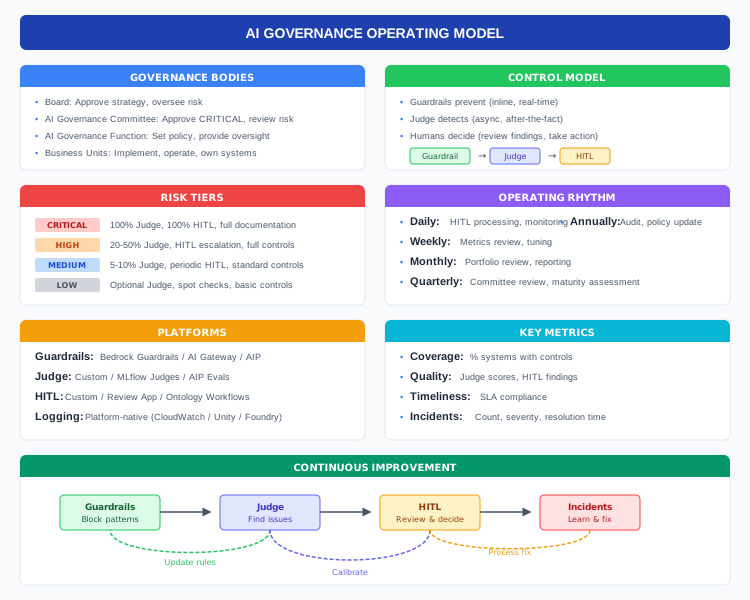
AI Governance Operating Model - ISO 42001 Alignment
This document defines how a centralised AI governance function operates in alignment with ISO 42001:2023 (AI Management System) while leveraging the control framework (guardrails, Judge, HITL) and enterprise AI platforms.
Executive Summary
ISO 42001 establishes requirements for an AI Management System (AIMS)-a structured approach to governing AI across the organisation. This document maps:
- ISO 42001 clauses → Framework controls
- Centralised governance function → Roles, responsibilities, processes
- Platform capabilities → Technical implementation (Bedrock, Databricks, Foundry)
- Operating rhythm → Governance cadence and decision rights
Core principle: Centralised policy, federated execution, unified assurance.
ISO 42001 Structure Overview
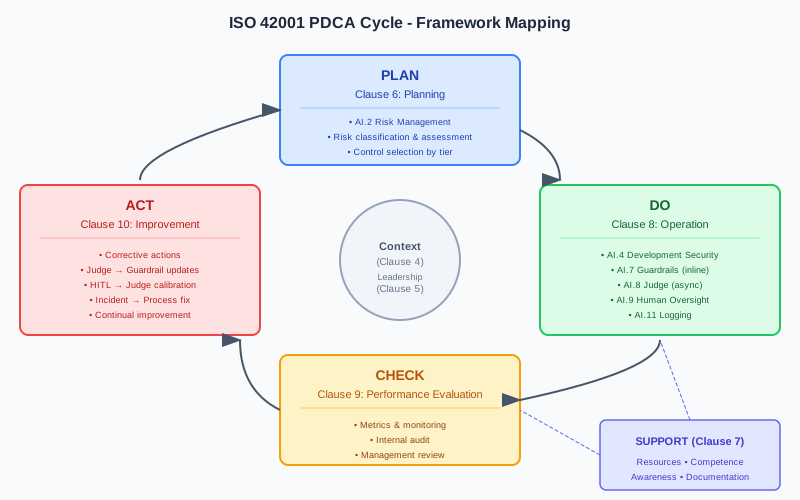
ISO 42001 follows the Annex SL high-level structure common to all ISO management systems:
| Clause | Title | Focus |
|---|---|---|
| 4 | Context of the organisation | Understand internal/external factors affecting AI |
| 5 | Leadership | Management commitment and policy |
| 6 | Planning | Risk assessment and objectives |
| 7 | Support | Resources, competence, awareness, communication |
| 8 | Operation | AI system lifecycle controls |
| 9 | Performance evaluation | Monitoring, measurement, audit, review |
| 10 | Improvement | Nonconformity, corrective action, continual improvement |
Annex A provides AI-specific controls (similar to ISO 27001 Annex A for information security).
Governance Operating Model
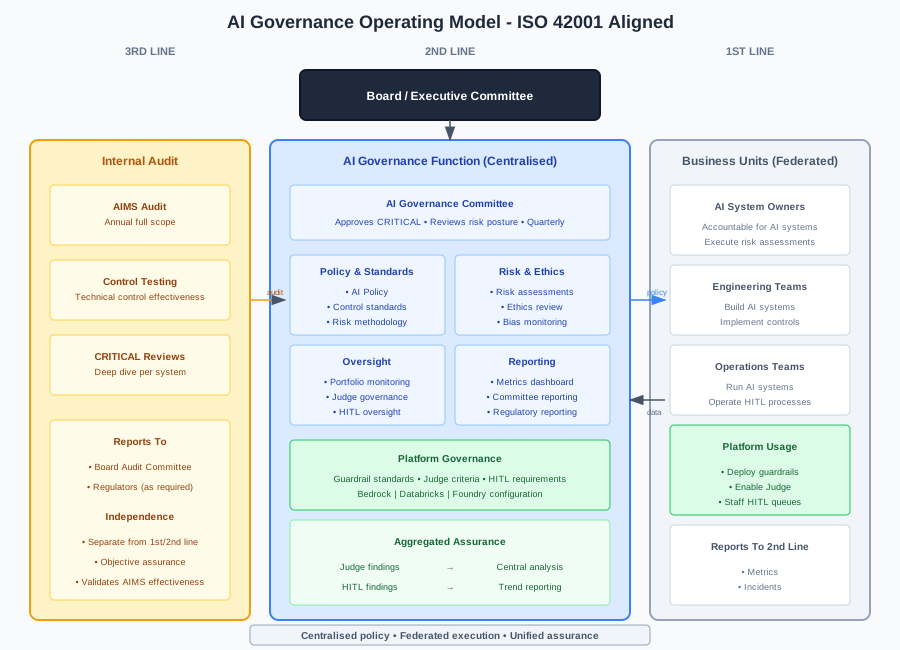
Three Lines Model for AI
| Line | Function | AI Governance Role |
|---|---|---|
| 1st Line | Business / Engineering | Build and operate AI systems; execute controls |
| 2nd Line | AI Governance / Risk | Set policy; provide oversight; operate assurance |
| 3rd Line | Internal Audit | Independent assurance; validate effectiveness |
Centralised vs Federated
| Aspect | Centralised (AI Governance Function) | Federated (Business Units) |
|---|---|---|
| Policy | ✅ Sets AI policy and standards | Implements policy |
| Risk framework | ✅ Defines risk tiers and methodology | Performs risk assessments |
| Control standards | ✅ Defines control requirements | Implements controls |
| Tooling/platforms | ✅ Selects and governs platforms | Uses platforms |
| Judge configuration | ✅ Defines evaluation criteria | May customise for use case |
| HITL processes | ✅ Defines requirements | Staffs and operates |
| Monitoring | ✅ Aggregates and reports | Monitors own systems |
| Approval (CRITICAL) | ✅ Approves CRITICAL deployments | Requests approval |
| Approval (HIGH) | Reviews | ✅ Approves with risk sign-off |
| Approval (MEDIUM/LOW) | Spot checks | ✅ Self-service with standards |
ISO 42001 Clause Mapping
Clause 4: Context of the Organisation
4.1 Understanding the organisation and its context
| Requirement | Framework Implementation |
|---|---|
| Identify external factors | Regulatory landscape (EU AI Act, sector regulations), competitive environment, technology trends |
| Identify internal factors | AI maturity, risk appetite, existing capabilities, culture |
4.2 Understanding the needs and expectations of interested parties
| Interested Party | Needs/Expectations | How Addressed |
|---|---|---|
| Regulators | Compliance, transparency, human oversight | Risk classification, HITL, audit trail |
| Customers | Fair treatment, privacy, accuracy | Guardrails, Judge quality monitoring, bias testing |
| Employees | Clear guidance, training, tools | Policy, standards, platform governance |
| Board/Executives | Risk management, value delivery | Governance reporting, metrics |
| Data subjects | Rights respected, explanations | HITL for decisions, documentation |
4.3 Determining the scope of the AIMS
Scope statement should define: - Which AI systems are in scope (all? production only? above certain risk tier?) - Which lifecycle stages (development, deployment, operation, retirement) - Organisational boundaries - Exclusions and justifications
4.4 AI Management System
The AIMS comprises: - This governance operating model - The control framework (AI.1–AI.12) - Platform implementations (guardrails, Judge, HITL) - Supporting processes and documentation
Clause 5: Leadership
5.1 Leadership and commitment
| Requirement | Implementation |
|---|---|
| Top management demonstrates commitment | Board/ExCo AI governance charter |
| Policy aligned with strategic direction | AI strategy linked to business strategy |
| Integration with business processes | AI controls embedded in SDLC, procurement, vendor management |
| Resources available | Funded AI governance function, platform investment |
| Achieving intended outcomes | Metrics and reporting to leadership |
5.2 AI Policy
The AI Policy should address:
AI Policy - Key Elements
- Purpose and scope
- Alignment with organisational values
- Commitment to responsible AI principles
- Risk-based approach to AI governance
- Roles and responsibilities
- Compliance with applicable laws and regulations
- Commitment to human oversight
- Continuous improvement commitment
- Review and update cycle
5.3 Organisational roles, responsibilities, and authorities
| Role | Responsibilities | Authority |
|---|---|---|
| Board / ExCo | Approve AI strategy and policy; oversee AI risk | Final accountability |
| AI Governance Committee | Approve CRITICAL deployments; review AI risk posture; escalation body | Approval for CRITICAL tier |
| Chief AI Officer / Head of AI | Lead AI strategy and governance function | Policy decisions |
| AI Risk Lead | Manage AI risk framework; oversee assessments | Risk methodology |
| AI Ethics Lead | Advise on ethical considerations; review sensitive use cases | Ethics review |
| Business Unit AI Leads | Implement AI governance in business units; own AI systems | LOCAL execution |
| AI Platform Team | Operate AI platforms; implement technical controls | Platform standards |
| HITL Reviewers | Review Judge findings; make decisions on flagged items | Review decisions |
Clause 6: Planning
6.1 Actions to address risks and opportunities
| Framework Component | ISO 42001 Alignment |
|---|---|
| AI.2.1 Risk Classification | Systematic identification of AI risks |
| AI.2.2 Risk Assessment | Evaluation of likelihood and impact |
| Risk tier controls | Risk treatment through proportionate controls |
| Judge monitoring | Ongoing risk identification |
Risk Assessment Integration:
AI Risk Assessment Process
1. Identify
- Use case analysis
- Data sensitivity
- Decision impact
- Regulatory scope
2. Classify
- Apply risk tier methodology
- Document classification rationale
- Obtain appropriate approval
3. Treat
- Select controls per tier
- Implement guardrails, Judge, HITL
- Document residual risk
4. Monitor
- Judge ongoing evaluation
- HITL review findings
- Periodic reassessment
6.2 AI objectives and planning to achieve them
| Objective Category | Example Objectives | Metrics |
|---|---|---|
| Safety | Zero critical safety incidents | Incident count |
| Fairness | No significant bias in CRITICAL systems | Bias metrics |
| Quality | >95% Judge quality scores | Quality scores |
| Compliance | 100% regulatory compliance | Audit findings |
| Oversight | 100% HITL coverage for CRITICAL | HITL coverage |
| Transparency | Documentation complete for all HIGH+ | Documentation audit |
Clause 7: Support
7.1 Resources
| Resource Category | Requirements |
|---|---|
| AI Governance Function | Staffed with AI risk, ethics, technical expertise |
| Platform investment | Guardrails, Judge, HITL tooling |
| HITL capacity | Reviewers scaled to volume and SLAs |
| Training | AI governance training for all AI practitioners |
| External expertise | Access to legal, regulatory, ethics advisors |
Governance Function Sizing:
| Organisation Size | AI Portfolio | Recommended FTE |
|---|---|---|
| Small (<5 AI systems) | Low complexity | 1-2 FTE (may be part-time) |
| Medium (5-20 AI systems) | Mixed tiers | 3-5 FTE |
| Large (20-100 AI systems) | Multiple CRITICAL | 8-15 FTE |
| Enterprise (100+ AI systems) | Complex, regulated | 15-30+ FTE |
7.2 Competence
| Role | Required Competencies |
|---|---|
| AI Governance Lead | AI/ML fundamentals, risk management, regulatory knowledge |
| AI Risk Analyst | Risk assessment, AI systems, data analysis |
| AI Ethics Specialist | Ethics frameworks, bias assessment, stakeholder engagement |
| Platform Engineer | AI platforms, guardrails implementation, MLOps |
| HITL Reviewer | Domain expertise, judgement, documentation |
7.3 Awareness
All personnel involved with AI should be aware of: - The AI policy - Their contribution to AIMS effectiveness - Implications of not conforming - How to report concerns or incidents
7.4 Communication
| What | Who | When | How |
|---|---|---|---|
| AI policy | All staff | Onboarding, annually | Intranet, training |
| Governance requirements | AI practitioners | Project initiation | Standards documents |
| Risk decisions | Stakeholders | As needed | Governance forum |
| Performance metrics | Leadership | Quarterly | Dashboard, report |
| Incidents | Affected parties | As required | Incident process |
7.5 Documented information
| Document Type | Retention | Owner |
|---|---|---|
| AI Policy | Current + 3 years | AI Governance |
| Risk assessments | Life of system + 7 years | Business owner |
| Control documentation | Life of system + 7 years | Platform team |
| Judge evaluations | Per tier (90 days – 7 years) | Platform team |
| HITL decisions | Per tier (1 – 7 years) | HITL team |
| Audit reports | 7 years | Internal Audit |
Clause 8: Operation
8.1 Operational planning and control
This is where the framework controls (AI.1–AI.12) are implemented.
AI System Lifecycle Governance:
| Stage | Governance Activities | Controls |
|---|---|---|
| Ideation | Use case review, initial risk screening | AI.2.1 |
| Design | Risk assessment, control selection | AI.2.2, AI.3 |
| Development | Secure development, testing | AI.4, AI.5, AI.6 |
| Pre-deployment | Security review, approval | AI.4.3 |
| Deployment | Guardrails, logging enabled | AI.7, AI.11 |
| Operation | Judge monitoring, HITL review | AI.8, AI.9 |
| Change | Change assessment, re-approval if needed | AI.2, AI.4 |
| Retirement | Decommissioning, data retention | AI.3 |
8.2 AI risk assessment
See AI.2 Risk Management controls.
8.3 AI risk treatment
| Risk Tier | Treatment Approach |
|---|---|
| CRITICAL | Full controls, 100% Judge, 100% HITL decisions |
| HIGH | Full controls, 20-50% Judge sampling, HITL escalation |
| MEDIUM | Standard controls, 5-10% Judge sampling, periodic HITL |
| LOW | Basic controls, optional Judge, spot checks |
8.4 AI system impact assessment
For HIGH and CRITICAL systems, conduct: - Fundamental Rights Impact Assessment (FRIA) - required for EU AI Act high-risk - Data Protection Impact Assessment (DPIA) - if personal data involved - Bias and Fairness Assessment - especially for consequential decisions
Clause 9: Performance Evaluation
9.1 Monitoring, measurement, analysis, and evaluation
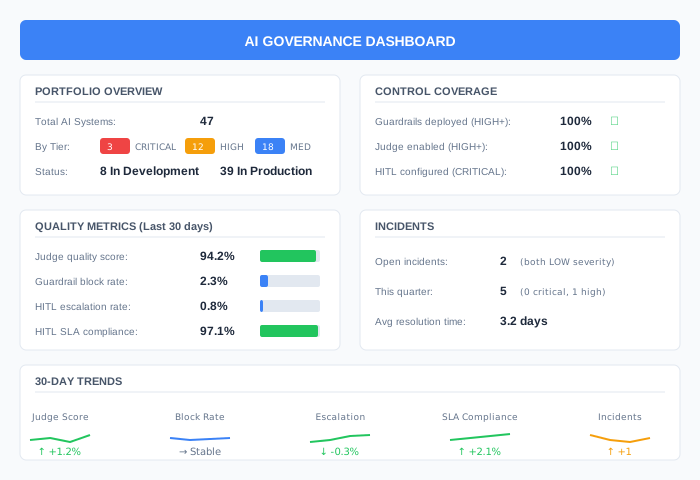
Governance Metrics Framework:
| Category | Metric | Target | Source |
|---|---|---|---|
| Coverage | % AI systems in inventory | 100% | Inventory |
| Coverage | % HIGH+ with guardrails | 100% | Platform |
| Coverage | % CRITICAL with 100% Judge | 100% | Platform |
| Quality | Judge quality score (avg) | >90% | Judge logs |
| Quality | HITL false positive rate | <20% | HITL records |
| Timeliness | HITL SLA compliance | >95% | HITL records |
| Incidents | AI safety incidents | 0 critical | Incident log |
| Compliance | Regulatory findings | 0 major | Audit reports |
| Maturity | Maturity assessment score | Per target | Assessment |
Governance Dashboard:
9.2 Internal audit
| Audit Type | Frequency | Scope | Auditor |
|---|---|---|---|
| AIMS audit | Annual | Full management system | Internal Audit |
| Control effectiveness | Annual | Technical controls sample | Internal Audit / 2nd Line |
| CRITICAL system review | Annual per system | Deep dive on CRITICAL systems | Internal Audit |
| HITL quality | Quarterly | Sample of HITL decisions | AI Governance |
| Judge calibration | Quarterly | Judge accuracy vs human | AI Governance |
9.3 Management review
AI Governance Committee - Quarterly Review Agenda:
- Performance metrics review
- Incident summary
- Risk posture update
- Regulatory developments
- CRITICAL system status
- Audit findings and actions
- Resource and capability needs
- Emerging risks and opportunities
- Improvement actions
Clause 10: Improvement
10.1 Continual improvement
Improvement sources: - Judge findings → guardrail updates - HITL feedback → Judge calibration - Incidents → process improvements - Audits → control enhancements - Regulatory changes → policy updates - Technology advances → capability improvements
10.2 Nonconformity and corrective action
| Nonconformity Type | Example | Response |
|---|---|---|
| Policy violation | AI deployed without approval | Stop, assess, remediate, prevent recurrence |
| Control failure | Guardrails bypassed | Investigate, fix, strengthen controls |
| HITL failure | SLAs consistently missed | Root cause, capacity adjustment |
| Incident | Customer harm from AI output | Incident response, customer remediation, process fix |
Platform Integration
How Platforms Support ISO 42001
| ISO 42001 Requirement | Bedrock | Databricks | Foundry |
|---|---|---|---|
| Risk treatment (8.3) | Guardrails | AI Gateway + Judge | AIP governance |
| Monitoring (9.1) | CloudWatch + custom | Unity Catalog + Lakehouse Monitoring | Inference history |
| Audit trail (7.5) | Inference logging | Inference Tables | Audit logs |
| Human oversight (8.4) | Build yourself | Review App + Deployment Jobs | Ontology workflows |
| Documentation (7.5) | Build yourself | MLflow tracking | Notepad + Model docs |
| Change control (8.1) | Build yourself | Model Registry + Deployment Jobs | Versioning + releases |
Recommended Architecture
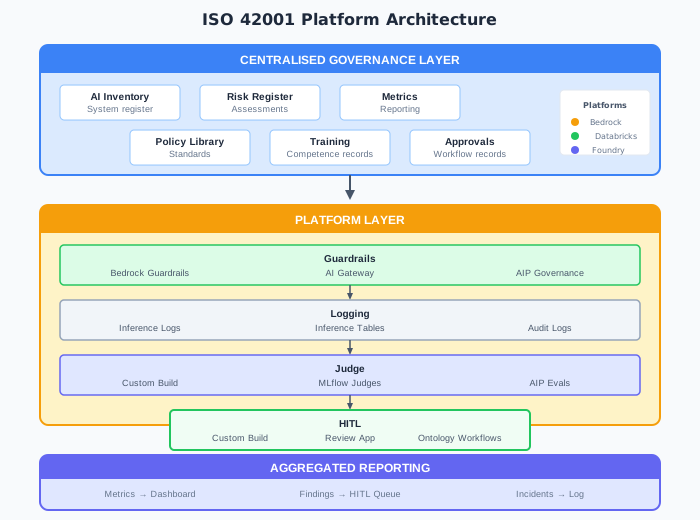
Governance Operating Rhythm
Daily
| Activity | Owner | Inputs |
|---|---|---|
| HITL queue processing | HITL Reviewers | Judge findings |
| Immediate escalation handling | On-call | Critical findings |
| Monitoring review | Platform Team | Dashboards |
Weekly
| Activity | Owner | Inputs |
|---|---|---|
| HITL metrics review | HITL Lead | Queue metrics |
| Guardrail tuning | Platform Team | False positive data |
| Incident triage | AI Risk Lead | Open incidents |
Monthly
| Activity | Owner | Inputs |
|---|---|---|
| Portfolio review | AI Governance Lead | Inventory changes |
| Metrics reporting | AI Governance Lead | All metrics |
| Judge calibration review | Platform Team | Calibration data |
Quarterly
| Activity | Owner | Inputs |
|---|---|---|
| AI Governance Committee | Committee Chair | Performance report |
| Maturity assessment | AI Governance Lead | Assessment criteria |
| Policy review | AI Governance Lead | Regulatory changes |
| HITL quality audit | AI Governance | Sample reviews |
Annually
| Activity | Owner | Inputs |
|---|---|---|
| AIMS internal audit | Internal Audit | Full scope |
| Management review | Senior Leadership | Annual report |
| Policy update | AI Governance Lead | All inputs |
| External audit (if certified) | External Auditor | Full scope |
| Training refresh | AI Governance | All AI practitioners |
Certification Considerations
Preparing for ISO 42001 Certification
| Phase | Activities | Duration |
|---|---|---|
| Gap assessment | Compare current state to ISO 42001 | 4-6 weeks |
| Remediation | Close gaps, implement missing controls | 3-6 months |
| Documentation | Complete AIMS documentation | 2-3 months |
| Internal audit | Verify readiness | 2-4 weeks |
| Management review | Confirm readiness | 1-2 weeks |
| Stage 1 audit | Documentation review | 1-2 days |
| Stage 2 audit | Implementation audit | 3-5 days |
| Certification | Certificate issued | - |
Common Certification Gaps
| Gap | Remediation |
|---|---|
| Incomplete AI inventory | Systematic discovery and registration |
| Missing risk assessments | Retrospective assessments for existing systems |
| No HITL for CRITICAL | Implement HITL processes |
| Inadequate documentation | Document existing practices |
| No Judge/quality assurance | Implement async evaluation |
| Governance not formalised | Establish committee, define roles |
Annex A Control Mapping
ISO 42001 Annex A provides AI-specific controls organised into nine sections (A.2 through A.10). The mapping below shows how the framework's core control families (AI.1 through AI.16) align with Annex A requirements. For the complementary infrastructure-level mapping (IAM, LOG, NET, DAT, etc.), see the ISO 42001 Annex A Infrastructure Mapping.
A.2 Policies Related to AI
| ISO 42001 Control | Framework Mapping | Notes |
|---|---|---|
| A.2.2 AI policy | AI.1.1 AI Policy Framework | ✅ Covered |
| A.2.3 Roles and responsibilities | AI.1.2 Governance Structure, AI.1.3 Accountability | ✅ Covered |
| A.2.4 Resources | AI.14 Security Awareness (training) | ✅ Covered |
A.3 Internal Organisation
| ISO 42001 Control | Framework Mapping | Notes |
|---|---|---|
| A.3.2 AI system inventory | AI.3.1 AI System Inventory | ✅ Covered |
| A.3.3 AI system requirements | AI.4 Development Security | ✅ Covered |
| A.3.4 Third-party components | AI.13 Supplier Management, AI.6 Model Security | ✅ Covered |
A.4 Resources for AI Systems
| ISO 42001 Control | Framework Mapping | Notes |
|---|---|---|
| A.4.2 AI risk assessment | AI.2.2 Risk Assessment | ✅ Covered |
| A.4.3 AI risk treatment | AI.2.3 + Risk tier controls | ✅ Covered |
| A.4.4 Residual risk acceptance | Governance approval workflows | ✅ Covered |
A.5 Assessing Impacts of AI Systems
| ISO 42001 Control | Framework Mapping | Notes |
|---|---|---|
| A.5.2 Data acquisition | AI.5 Data Governance | ✅ Covered |
| A.5.3 Data quality | AI.5.2 Data Quality | ✅ Covered |
| A.5.4 Data provenance | AI.13.3 Model Provenance (includes data) | ✅ Covered |
| A.5.5 Data preparation | AI.5 Data Governance | ✅ Covered |
A.6 AI System Life Cycle
| ISO 42001 Control | Framework Mapping | Notes |
|---|---|---|
| A.6.2.2 Design | AI.4.1 Secure Development | ✅ Covered |
| A.6.2.3 Data processing | AI.5 Data Governance | ✅ Covered |
| A.6.2.4 Model building | AI.4 Development Security | ✅ Covered |
| A.6.2.5 Validation | AI.6.2 Model Validation | ✅ Covered |
| A.6.2.6 Verification | AI.4.2 Testing | ✅ Covered |
| A.6.2.7 Deployment | AI.4.3 Deployment Security | ✅ Covered |
A.7 Data for AI Systems
| ISO 42001 Control | Framework Mapping | Notes |
|---|---|---|
| A.7.2 Operation and monitoring | AI.8 Judge, AI.11 Logging & Monitoring | ✅ Covered |
| A.7.3 Human oversight | AI.9 Human Oversight (HITL) | ✅ Covered |
| A.7.4 Explainability | AI.3.2 Documentation, Judge reasoning capture | ✅ Covered |
| A.7.5 Bias management | AI.8 Judge (bias evaluation), AI.9 HITL | ✅ Covered |
A.8 Information for Interested Parties
| ISO 42001 Control | Framework Mapping | Notes |
|---|---|---|
| A.8.2 Performance monitoring | AI.8 Judge, AI.11 Monitoring | ✅ Covered |
| A.8.3 Performance evaluation | Judge metrics, calibration | ✅ Covered |
A.9 Use of AI Systems
| ISO 42001 Control | Framework Mapping | Notes |
|---|---|---|
| A.9.2 Change management | AI.4.4 Change Management (added) | ✅ Covered |
| A.9.3 Incident management | AI.12 Incident Response | ✅ Covered |
| A.9.4 Problem management | AI.12, Feedback loops | ✅ Covered |
A.10 Third-Party and Customer Relationships
| ISO 42001 Control | Framework Mapping | Notes |
|---|---|---|
| A.10.2 Corrective action | Clause 10 processes, feedback loops | ✅ Covered |
| A.10.3 Continual improvement | PDCA cycle, Judge→Guardrail feedback | ✅ Covered |
Agentic AI Mapping (Framework Extension)
ISO 42001 does not explicitly address agentic AI. The framework extends coverage:
| Agentic Concern | ISO 42001 Nearest | Framework Control |
|---|---|---|
| Plan approval | A.7.3 Human oversight | AG.1.3 Plan Approval |
| Action constraints | A.4.3 Risk treatment | AG.2.1-2.4 Execution Controls |
| Circuit breakers | A.8.2 Monitoring | AG.2.2 Circuit Breakers |
| Trajectory evaluation | A.8.3 Performance | AG.3.2 Trajectory Evaluation |
| Multi-agent governance | A.3.2 Inventory | AG.4 Multi-Agent Controls |
Cross-Reference: Framework to ISO 42001
| Framework Control | ISO 42001 Clause | ISO 42001 Annex A |
|---|---|---|
| AI.1 Governance | 5 Leadership | A.2 |
| AI.2 Risk Management | 6 Planning | A.4 |
| AI.3 Inventory & Documentation | 7.5 Documented info | A.3.2 |
| AI.4 Development Security | 8.1 Operational planning | A.6 |
| AI.5 Data Governance | 8.1 | A.5 |
| AI.6 Model Security | 8.1 | A.6.2 |
| AI.7 Guardrails | 8.1 | A.4.3, A.7.2 |
| AI.8 Judge | 9.1 Monitoring | A.8 |
| AI.9 Human Oversight | 8.1 | A.7.3 |
| AI.10 Agentic Controls | - (extension) | - |
| AI.11 Logging & Monitoring | 9.1 | A.7.2, A.8.2 |
| AI.12 Incident Response | 10.2 Nonconformity | A.9.3 |
| AI.13 Supplier Management | 8.1 External provision | A.3.4 |
| AI.14 Security Awareness | 7.2, 7.3 Competence | A.2.4 |
| AI.15 Business Continuity | 8.1 | - |
| AI.16 Intellectual Property | 7.5 | - |
Summary
Key Success Factors
- Executive sponsorship - AI governance needs visible leadership support
- Clear accountability - Named owners for AI systems and governance
- Proportionate controls - Match controls to risk tier
- Platform enablement - Technical controls make governance practical
- Feedback loops - Continuous improvement from Judge findings and HITL
- Metrics-driven - Measure what matters, report to leadership
The Operating Model in One Page