Multi-Agent Risk Evaluation Demonstrator
Interactive demo
Launch the interactive pipeline demo to watch pre-recorded scenarios play through the full evaluation pipeline with animated step-by-step playback.
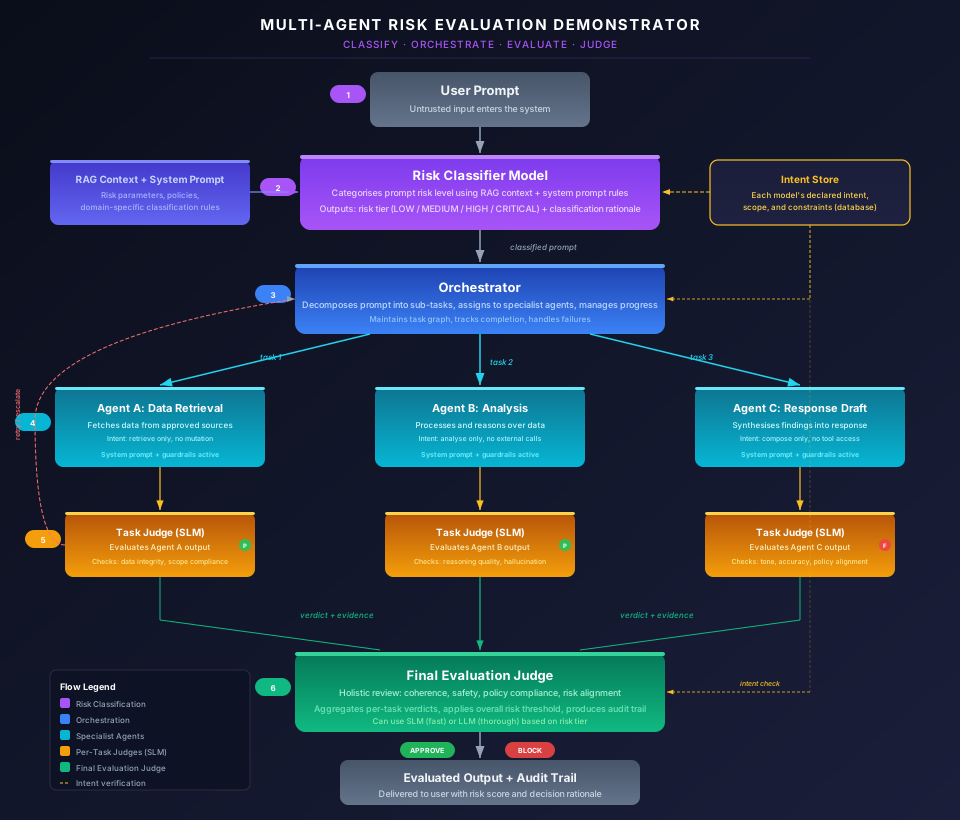
This demonstrator walks through the end-to-end flow of a prompt as it moves through a multi-agent system with layered risk evaluation. Every model in the pipeline has a declared intent statement stored in a central intent store (database), and every step is observable.
How it works
The system has six stages. Each stage is visible to operators and auditors in real time.
Step 1: User prompt enters the system
A user submits a natural-language prompt. At this point, the input is untrusted. No assumptions are made about intent, safety, or scope.
Step 2: Risk Classifier assigns a risk tier
A dedicated classification model examines the prompt. It draws on two sources:
- RAG context and system prompt rules that define the organisation's risk taxonomy, policies, and domain-specific classification logic.
- Intent Store lookups that retrieve the declared intent statements for downstream models, so the classifier can assess whether the prompt falls within the system's operational scope.
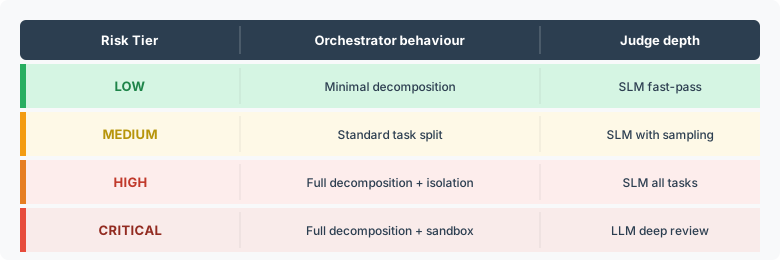
The classifier outputs a risk tier (LOW, MEDIUM, HIGH, or CRITICAL) along with a rationale. This tier shapes how aggressively the orchestrator and judges operate.
Step 3: Orchestrator decomposes and assigns
The orchestrator receives the classified prompt and breaks it into sub-tasks. Each task is assigned to a specialist agent based on capability, scope, and the principle of least privilege.
The orchestrator:
- Maintains a task graph tracking dependencies, completion status, and failures.
- Enforces delegation contracts that specify what each agent is allowed to do.
- Reads each agent's intent statement from the intent store before dispatch, confirming the task matches the agent's declared scope.
- Manages retries and escalation when per-task judges flag problems.
Step 4: Specialist agents execute their tasks
Each agent operates within strict boundaries defined by its system prompt and guardrails:
| Agent | Scope | Intent constraint |
|---|---|---|
| Agent A: Data Retrieval | Fetches data from approved sources | Read-only, no mutation |
| Agent B: Analysis | Processes and reasons over data | No external calls, no tool access |
| Agent C: Response Draft | Synthesises findings into a response | Compose only, no tool access |
Every agent has:
- A system prompt that defines its role and boundaries.
- Input/output guardrails that filter known-bad patterns.
- A declared intent in the intent store that the judges verify against.
Step 5: Per-task judges evaluate each agent (SLM)
Each agent's output is evaluated by a small language model (SLM) acting as a task judge. These judges run in near real-time and check:
| Judge for | Checks |
|---|---|
| Agent A | Data integrity, source approval, scope compliance |
| Agent B | Reasoning quality, hallucination detection, chain-of-thought coherence |
| Agent C | Tone, factual accuracy, policy alignment, no leaked instructions |
Each judge produces a verdict (pass, fail, or flag) with supporting evidence. Failed tasks trigger one of:
- Retry: the orchestrator re-dispatches the task with tighter constraints.
- Escalation: the task is routed to the final judge or a human reviewer.
Step 6: Final Evaluation Judge delivers the overall verdict
The final judge aggregates all per-task verdicts and performs a holistic review:
- Coherence: do the combined agent outputs form a consistent, non-contradictory answer?
- Safety: does the assembled response violate any safety policy?
- Policy compliance: is the response within the organisation's acceptable use boundaries?
- Risk alignment: does the final output match what the risk tier permits?
The final judge can be an SLM (for LOW/MEDIUM tiers where speed matters) or an LLM (for HIGH/CRITICAL tiers where thoroughness matters). Its output is a decision: APPROVE or BLOCK, with a full audit trail attached.
The Intent Store
Every model in the pipeline has a record in the intent store:
{
  "model_id": "agent-b-analysis-v2",
  "intent": "Analyse retrieved data using reasoning. No external API calls. No tool invocations. Output structured analysis only.",
  "scope": ["data_analysis", "reasoning"],
  "constraints": ["no_external_calls", "no_tool_use", "no_mutation"],
  "risk_ceiling": "HIGH",
  "last_verified": "2026-03-21T00:00:00Z"
}
Judges compare actual behaviour against declared intent. A mismatch (for example, an analysis agent attempting an external API call) triggers an immediate block, regardless of whether the output looks correct.
What users see
The demonstrator is designed so that observers can follow the entire flow:
- Prompt entry: the raw user input is displayed.
- Risk classification: the assigned tier and rationale appear alongside the prompt.
- Task decomposition: the orchestrator's task graph is shown, with each sub-task and its assigned agent.
- Agent execution: each agent's input, output, and active guardrails are visible.
- Per-task verdicts: pass/fail indicators with evidence are shown next to each agent.
- Final verdict: the overall decision (APPROVE/BLOCK) with the aggregated audit trail.
Each stage lights up as the system processes the prompt, making the decision pipeline transparent from start to finish.
Mapping to AIRS controls
| Demonstrator stage | AIRS control |
|---|---|
| Risk Classifier | Risk Tiers, Risk Assessment |
| Orchestrator | Multi-Agent Controls, Delegation Chains |
| Specialist Agents | Agentic AI Controls, Tool Access Controls |
| Per-Task Judges | Judge Assurance, Model-as-Judge Implementation |
| Final Judge | Judge Model Selection, Distilling the Judge into an SLM |
| Intent Store | Identity & Access |